
The Same Wellness Technique That Helps You Monday Can Make You Worse Wednesday
What We Learned From Measuring Over 1,000 Nervous System Regulation Sessions
Your nervous system is different every day, and that means it needs a different regulation practice every day. How you slept, what you ate, how stressed you are, whether you had caffeine, your medication, your mental health — all of it changes the inputs (nervous system regulation techniques) your body can receive that day, and which ones it can’t.
The breathing exercise that calmed you down yesterday, might do nothing today. The technique your friend swears by might actually make you feel worse.
IMIN wanted to know: how often does this happen? And what can we do about it?
Over the course of two weeks, we measured it in our Beta test and collected over 1,000 sessions. Each session had the user perform a rPPG biometric reading prior to completing the technique, perform a technique of their choice, and perform a rPPG biometric reading after. In this way, we look at the question “what did your nervous system actually do?” after performing a wellness technique.
Why Nervous System Regulation Techniques
A nervous system regulation technique is any practice or intervention designed to restore or maintain the nervous system’s flexibility, balance, and coordination (regulated), particularly when it has become stuck, rigid, or collapsed (dysregulated).
Regulation is your nervous system’s ability to be flexible, balanced, and coordinated, regardless of whether you’re calm or activated.
Dysregulation is when the nervous system’s ability to be flexible, balanced, and coordinated breaks down and the system gets stuck, rigid, or collapses, regardless of whether you feel stressed or fine.
Regulating means your nervous system stays flexible enough to handle what’s happening, and it can perform the desired function (relax, focus, or energize) instead of getting stuck in a dysregulated state that makes everything harder.
Regulation is not always about being zen. It’s about not being hijacked by your own body.
That’s why IMIN differentiates your intention: do you want to relax, focus, or energize. Knowing what your intention is, IMIN can help you occupy that state in a regulated manner.
Without IMIN’s pairing technology, the Technique Didn’t Help
Not all Nervous System Regulation Techniques help. This is not because the techniques are bad. IMIN’s data showed that for a technique to be effective, it had to meet the person where they were at: their current biometric state indicated what inputs (nervous system regulation techniques) the body could and could not accept.
IMIN’s data shows that in order for technique matching to be successful to the person, two things needed to be taken into account: 1) the person’s current nervous system state 2) why the person wants to regulate (is it to relax, to focus, or to energize?)
When people used techniques that weren’t matched to their body’s current state or desired outcome, only about half the sessions produced a meaningful positive shift.
One of the key takeaways from IMIN’s data was that techniques that regulate one person can dysregulate another when not matched to current body state and intention. Roughly 1 in 5 sessions made things actively worse. In 20% of sessions, a well-meaning technique actually dysregulated the user, leaving their nervous system measurably more stressed after the session than before it. Again, this was not about the technique. That same technique would help another person who was in a different nervous system state, with a different intention. Technique matching with all known user contexts resulted in 85% success. While not 100%, with IMIN matching, none of those sessions resulted in a more dysregulated state, they simply didn’t move the system one way or another.
This means your nervous system isn’t just responding to which technique you pick. It’s responding to the combination of which technique, what state your body is in right now, and what you’re trying to achieve. Get any one of those wrong, and the session is likely to fail, or even make things worse and more dysregulated.
What differentiates IMIN from other wellness apps out there is that other wellness apps fall into the trap of believing it is the technique that creates the change, they give you a technique and hopes for the best. IMIN understands you in totality: your state, your history, your intention, and the technique that fits both. That’s why it works.
Understanding Regulation and Dysregulation
Regulation is not about being calm. It’s about your nervous system being organized.
Four things have to be true at once for regulation to be in place:
Your vagus nerve is active: it has enough strength to influence your heart, your breathing, your gut. This is the foundation. Without vagal tone, the system has no brakes.
Your system is flexible: it can shift. It’s not locked into one gear. A regulated nervous system has room to move up when it needs to and come back down when it’s done.
Your two branches are balanced: sympathetic (activating systems) and parasympathetic (calming systems) aren’t fighting each other and neither one has taken over completely. There’s a ratio, and it sits in a range where both branches are doing their job.
Your heart and lungs are coordinated: they’re talking to each other. When one moves, the other responds. The subsystems are working as a system, not separately.
You can be regulated and stressed. High stress with good organization means the system is doing what it’s supposed to do, it’s responding to a real demand. That’s why our data shows that high stress states often respond to techniques much more quickly than deregulated states. The system is activated but organized, so there’s a clear target to move toward.
Dysregulation is when the organization falls apart.
Dysregulation is not just about “feeling bad.” In a dysregulated state, the nervous system loses its structure. Your vagal tone drops and when that happens, it is as if your brakes stop working. Flexibility collapses and the system gets rigid, and enters a locked into a state it can’t shift out of. The balance tips too far in one direction and one branch (the activating system or the relaxing system) dominates. Your heart and lungs decouple and also stop coordinating.
When this happens, it can look “calm”. For example, one of IMIN’s state of “Blunt Restorative” is a high parasympathetic (calming systems), low sympathetic (activating systems) state, and the person looks fine from the outside. But, if we look closer-the system hasn’t chosen to rest. It’s a dysregulated shut down. That’s why our data shows that the calming techniques that we anticipate would help a person relax, actually makes people in a Blunted state worse most of the time. IMIN’s data understands that to push a Blunted state person into relaxation is like pushing a shutdown system deeper into shutdown.
Likewise, dysregulation can also be caused by the wrong technique. That’s the 1 in 5 sessions where the person’s nervous system is measurably worse after than before.
Regulation is your nervous system’s ability to be flexible, balanced, and coordinated, regardless of whether you’re calm or activated.
Dysregulation is when that organization breaks down and the system gets stuck, rigid, or collapses, regardless of whether you feel stressed or fine.
Your Nervous System Is Different Every Day- Individual Case Studies
Dysregulation shows up differently for everyone.
User 1 in IMIN’s study completed 83 sessions in 1 month. Across those sessions, their nervous system showed up in 9 different configurations. These 9 states fell into “activated” states 68% of the time. User 1’s states ran “hot” and they arrived dysregulated about 1 in 3 sessions. Running hot, in sympathetic states, meant user 1’s dysregulation is visible — they present as stressed, wired, activated.
When not in an activated state, they frequently sat in a mildly dysregulated zone— 29% of the time (of the remaining 32% sessions) . That’s the murky middle where the system is slightly disorganized but not obviously in crisis. It’s the zone where technique selection matters most because the system could go either way.
User 1’s mean regulation score was technically positive, but just barely. Even though 2 out of 3 sessions were regulated, this is a person whose nervous system hovers close to the line between organized and disorganized.
To compare how dysregulation can show up differently, let’s look at User 2.
Across 69 sessions, User 2’s nervous system showed up in 11 different configurations. Those 11 states fell into freeze and shutdown states 51% of the time. Where User 1 ran hot, User 2 ran cold — their system’s default position was in a “freeze” state.
Their dysregulation is the opposite of User 1’s — and far harder to see. User 1’s disorganization announces itself externally. User 2 arrived looking calm, measured, rested. But, IMIN can see that User 2’s system hasn’t relaxed into rest, it has collapsed into conservation.
User 2 spent 23% of sessions in deep freeze and another 29% in soft freeze — states that sit on the edge between genuine recovery and passive collapse. That soft freeze zone is their murky middle: the system looks like it’s resting but lacks the responsiveness that real rest produces. It’s where technique selection matters a great deal, because pushing too hard deepens the shutdown, and doing nothing keeps them stuck.
User 2’s nervous system configuration was the opposite nervous system of User 1. User 1 ran hot and mildly dysregulated: sympathetic overdrive, wired, activated. User 2 ran cold: their nervous system’s default was shutdown.
Takeaways: people’s nervous systems change frequently (they don’t just fall into one state, but many), and at the same time, they have chronic patterns.
Even though User 1 often ran “hot”, they did not always. Similarly, User 2 was in shutdown 50% of the time.
The same person’s nervous system, measured repeatedly, changed often. While they also showed chronic patterns, and states they were in most often, regulation techniques based on their chronic states were not helpful, they needed daily adjustments because their systems changed based on daily context matters- such as a bad night of sleep or increased caffeine intake that would require a different technique to match their current state.
It is important to know how you are doing today because our data showed:
A bad night of sleep makes movement-based techniques significantly less effective. But gentle touch-based techniques actually work better when you’re exhausted. Your body responds to the thing that asks the least of it.
Caffeine makes your body resist slowing down. Breathwork dysregulates the body.. But movement works better after caffeine, your body already has the energy, it just needs somewhere to put it. IMIN’s data says: Don’t fight the caffeine. Move with it.
After a workout, your nervous system is primed and flexible. Touch lands harder. Sensory techniques hit faster. If you can choose when to regulate, do it after you move.
Even when you land in a chronic pattern repeatedly, the technique that worked yesterday might not work today. Not because it’s a bad technique but rather because your sleep, your caffeine, your stress, and your body’s state shifted. When a technique is matched to your state, daily contexts, your nervous system can receive the inputs it needs to shift in the right direction.
Without IMIN, the technique isn’t wrong. The match is wrong, and it changes every day.
Your Mental Health Changes the Configuration of Your Nervous System
Your mental health doesn’t just affect how you feel, it also changes how your nervous system is wired when you try to regulate. IMIN’s data shows that mental health differences can impact which techniques your body can receive.
It is important to know your mental health context because our data showed:
SSRIs and other medications change which techniques your nervous system can respond to. In IMIN’s data, breathwork became dramatically less effective for people on common psychiatric medications.
ADHD shifts how your body responds. People with ADHD in our study responded differently than those without, but not worse. They just needed different techniques. For example, touch-based approaches worked especially well. Breathwork, which requires sustained focus, often dysregulated them.
Similarly, Trauma doesn’t make you a worse responder. It makes you a different responder. People with trauma histories showed strong improvements in IMIN’s study when using movement based exercises, but visual and auditory techniques often backfired. The body that’s been through trauma has a different map than one which has not.
Your mental health isn’t a limitation. It’s a routing instruction. The nervous system of someone with ADHD, or on an SSRI, or carrying trauma isn’t broken, it just needs a different match.
What Happens When You Match the Technique to the Person
IMIN tested what happens at every level of matching, from knowing nothing about you to knowing everything. The results tell a clear story: the more IMIN knows, the better it gets.
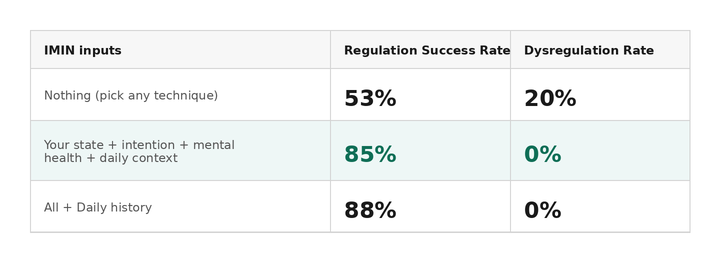
When IMIN can match you to the specific technique that works best for your state — not just the right category, but the right technique — success jumps to 85%.
Every session teaches the system more about what your body responds to. At 85% success, nearly 9 out of 10 sessions produce a meaningful positive shift. And the risk of a technique making you worse drops to nearly zero.
Your Body Isn’t Simple — and It Shouldn’t Be Treated That Way
The wellness industry treats your nervous system like it has two settings: stressed or calm, regulated or dysregulated. IMIN has found 20 distinct nervous system states — each with its own pattern and its own needs.
Two of these states show why this matters:
When you’re in overdrive — stressed, activated, heart racing — most techniques work. Simple techniques like a cold cloth on your neck or stepping outside work about 73% of the time. Your nervous system has a clear direction to move in.
When you’re shut down — numb, flat, exhausted but not in an obvious way — most calming techniques make it worse. They push your nervous system deeper into the hole it’s already in. Only specific activating techniques help. And the success rate drops to 33%, meaning the number of techniques that work are limited and require precision matching.
These two states feel similar from the inside (”I don’t feel good”). But they need opposite interventions. Without measuring, you can’t tell which one you’re in.
What Your Intention Changes
We scored every session for three different intentions — relax, focus, and energize — and found that the best technique depends entirely on what you’re trying to achieve.
The top techniques for relaxation are completely different from the top techniques for energizing. A technique that ranks #1 for calming can rank last for focus. This means a single “recommended technique” is never enough — you need different recommendations for different intentions, on different days, based on different starting states.
The Techniques That Can Make You Worse
This is the part nobody talks about.
Some techniques in our data made people worse more often than they helped. Not because the techniques are inherently bad, but because they were applied to the wrong state.
For example: if your nervous system is already well-regulated and you do an intense breathwork technique, there’s a significant chance it destabilizes what was already working well. Your body didn’t need to be pushed — it needed to be gently redirected.
Without measuring, you’d never know this happened. You’d finish the session, think “that felt okay,” and have no idea your nervous system just took a step backward.
This is why we measure every session. Not to judge techniques but to protect you from the wrong match.
What IMIN Does Differently
Every other wellness app tracks whether you showed up. IMIN tracks whether it worked.
Before every session: a quick scan reads your nervous system’s current state. Based on that state and your intentions (relax, focus, or energize), IMIN recommends the technique most likely to work for you, right now. After the session: another scan measures what actually happened. The system scores the outcome and learns from it.
Biometric wearables give you a lot of data, but don’t offer solutions. Wellness apps give you many solutions but don’t personalize the technique to you and your data. IMIN does both.
IMIN also wants to be accessible, and that is why we use a camera scan. Multiple studies show that rPPG (face scan) correlates above 95% with contact PPG (wearables such as Oura and Whoop). Unlike wearables, IMIN does not require a hardware purchase, eliminating the high cost barrier to entry.
Key Takeaways
Your nervous system changes every day. Sleep, stress, caffeine, medication, and mental health all shift which techniques will work for you. What helped yesterday might not help today.
About half of regulation sessions don’t produce meaningful improvement when the technique isn’t matched to your current state. Roughly 1 in 5 can make things actively worse.
Where you start matters most. Your nervous system’s state before you begin is the single biggest factor in whether a technique will help.
Medications, ADHD, trauma, and sleep dramatically change what works for you. No other wellness app currently accounts for this.
Personalized matching works — and we’re getting better. After a few sessions, IMIN reaches up to 85% success with near-zero risk of making you worse. And we’re still improving.
How We Did This
We measured 1,082 nervous system regulation sessions across 122 people using 57 different techniques. Every session included biometric readings before and after, captured through smartphone-based HRV sensors. Our proprietary scoring system evaluates whether the technique shifted the person’s nervous system in the right direction for their intention, and whether it maintained the nervous system’s overall stability. Sessions are scored separately for each intention (relax, focus, energize) using intention-specific models. Mental health and lifestyle data (sleep, medication, ADHD, trauma) is self-reported by users.
This is observational product data, not a controlled clinical trial. Our approach builds on established neuroscience including Polyvagal Theory (Porges, 1994), Somatic Experiencing (Levine, 1997), and the Stanford physiological sigh study (Balban et al., 2023). This report is educational — it is not medical advice.
IMIN reads your nervous system and tells you exactly what it needs. The only app that knows whether your self care worked.
© 2026 IMIN. For questions, contact info@getimin.app.
